
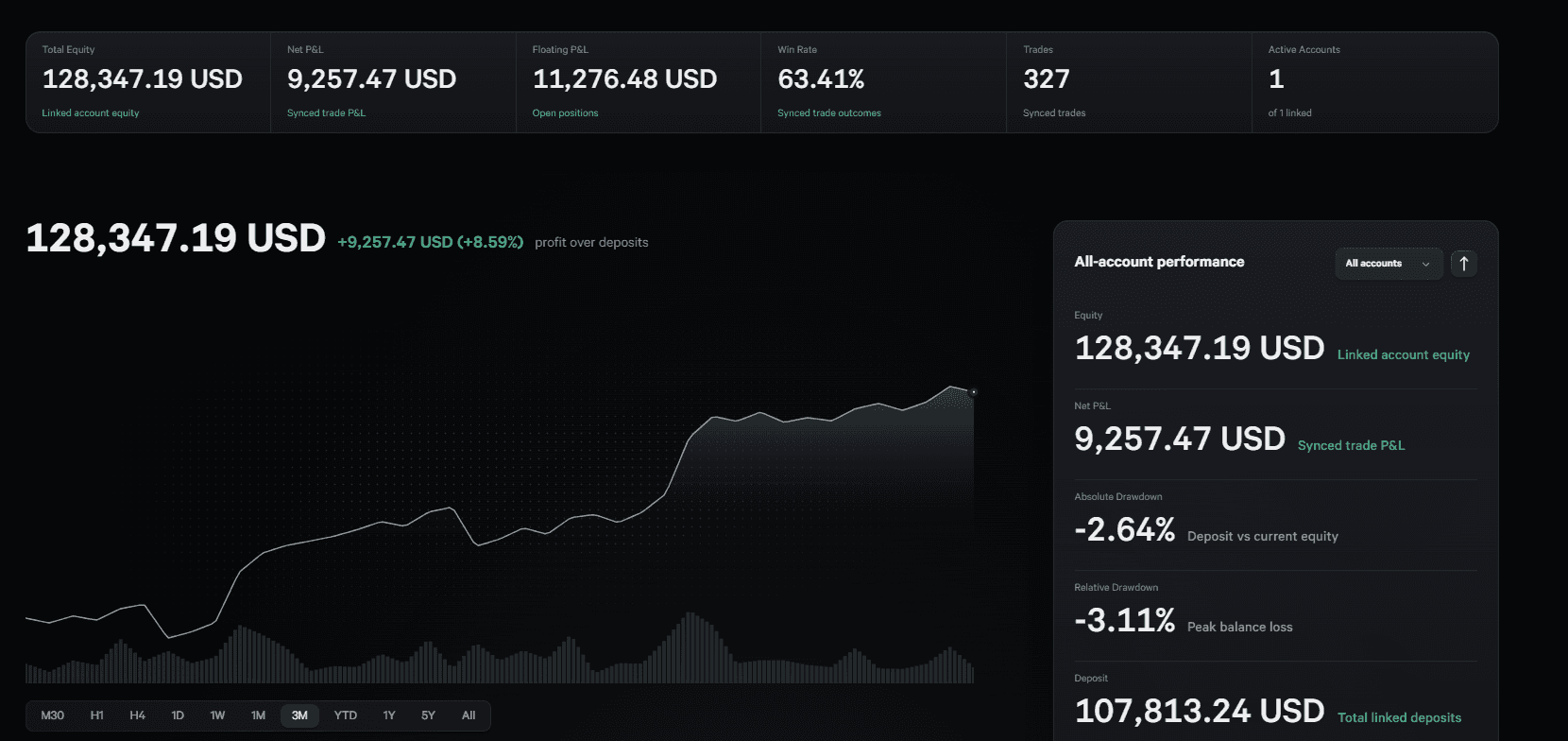
Deposits and withdrawals change account balance but are not trading performance. Reconcile external flows separately before calculating P&L, return, growth, or drawdown.
Apply this workflow in the Dojournal portfolio view and check account limits by plan before connecting a larger portfolio.
Key takeaways
- A balance increase can come from a deposit; a decrease can come from a withdrawal.
- Trading result equals the balance change after removing net external cash flow.
- Credits, rebates, transfers, fees, and currency conversion need an explicit classification.
- Use consistent flow-adjusted methods when comparing accounts or periods.
Balance change is not automatically P&L
MT5 balance records can include trade results, commissions, swaps, deposits, withdrawals, credits, rebates, and internal transfers. Comparing the first and last balance without classifying those rows mixes account funding with trading performance.
If an account starts at 10,000, receives a 5,000 deposit, and ends at 15,400, the balance grew by 5,400—but the trading result is 400 if there were no other external flows or adjustments.
Trading result = ending balance − starting balance − deposits + withdrawals
Classify every non-trade operation
Treat money intentionally added to or removed from the strategy as external cash flow. Then decide and document how broker credits, promotional bonuses, rebates, taxes, financing charges, and account-to-account transfers are handled. Their economic meaning can differ by broker and report.
Do not silently treat an unfamiliar balance row as profit. Keep it unclassified until the broker description or account record supports the decision.
Return needs a cash-flow convention
A simple return works when no external flow occurs during the period. When cash moves in or out, the timing changes how much capital was actually exposed. A deposit on the final day should not receive credit for profit earned earlier in the month.
For personal review, split the period at material cash flows or use a time-weighted method that links the sub-period returns. For money-manager reporting, a money-weighted return may answer a different question. State which method you use instead of comparing unlike percentages.
Cash flows also distort growth and drawdown charts
A deposit can create a new balance peak and make later drawdown look smaller in percentage terms. A withdrawal can create an artificial drop. An adjusted performance series should preserve the economic return while keeping the cash-flow event visible in the account record.
When comparing multiple MT5 accounts, convert values consistently and review each account’s external flows before combining them into a portfolio series.
Use a simple reconciliation checklist
Start with the opening balance. Add net closed trading results and all classified non-trade balance operations. The result should reconcile to the closing balance, allowing for the exact commission and swap convention used by the source.
Keep realized performance separate from floating P&L on open positions. When the numbers do not reconcile, investigate missing history, duplicate deals, currency conversion, or period boundaries before publishing a return.
- Opening and closing balance
- Deposits, withdrawals, transfers, and credits
- Gross trading P&L, commission, swap, and other fees
- Open-position floating P&L reported separately
Continue with a related topic in the Dojournal MetaTrader 5 article library.
Sources
The Dojournal editorial team reconciled the definitions with MetaTrader 5 documentation and checked the workflow against the current portfolio views. This is educational content, not investment advice.
Reviewed and maintained by Dojournal Editorial Team